Peronism (Justicialism)
The Disappearance of Josef MengelePeronism (Justicialism) appears as both a promise of social transformation and a means of consolidating authority. Under Juan Perón and Eva Perón, it connected worker-focused reforms and national independence to a leader-centered political culture, while suppressing institutions and dissent that stood outside its control. The book’s account emphasizes the tension between its language of popular liberation and the coercive order built in its name.
Formation and Political Promise
By 1946, Juan Perón and Eva Perón had become Argentina’s dominant political figures, supported by the church, military, nationalists, and working people. Juan Perón announced a proletarian regime and an aesthetic and industrial revolution, promising to end humiliation and dependency and to give Argentina a new beginning. The movement presented its program as a way to secure the country a consequential place in history, not merely as a change of government.
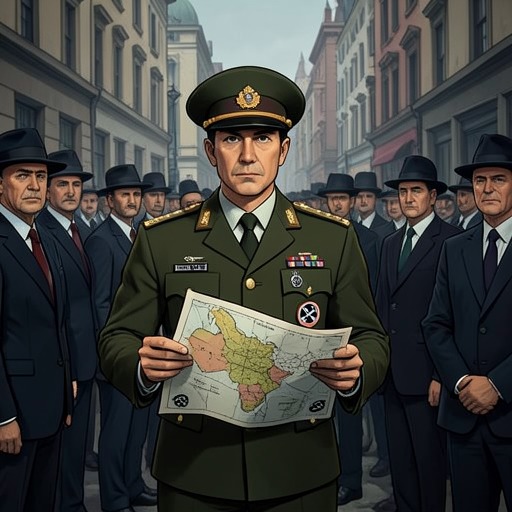
Juan Perón’s earlier experience abroad helped shape that ambition. While serving as a military attaché in Rome, he studied Fascist theory and war; he had also visited Germany, read Hitler’s writing, and admired the country’s highly organized state. In his later account of world politics, Fascist Italy and Nazi Germany represented an alternative to both capitalism and communism. This was his interpretation of the period, not a neutral description: he treated the Axis as an emerging third force and imagined Argentina taking its place after its defeat.
Social Reform and Eva Perón’s Public Role
Juan Perón challenged the privileges of Argentina’s agricultural oligarchy through state intervention and policies directed toward workers. As secretary of welfare he provided benefits to them; as president he strengthened public services and worked with the General Confederation of Labour, bringing the national union into the state apparatus. His government centralized and nationalized the railways, telephone network, and other strategic sectors held by foreign interests. The measures joined economic independence to a political claim that the state could speak for working people.
Eva Perón gave that claim a highly visible public form. She received union delegates, visited hospitals and factories, opened road sections, and distributed practical goods including dentures and sewing machines. Through her foundation she assisted poor and underprivileged people, while her tours and appearances carried the movement’s message to cheering crowds. In 1947, on her so-called rainbow tour, she was received by the Pope and heads of state. Her work made welfare, spectacle, and personal devotion parts of the same political image.
That image was tested dramatically on 22 August 1951, when hundreds of thousands gathered on Buenos Aires’s widest avenue for the announcement of the couple’s candidacy. Asked by the head of the General Confederation of Labour to accept the vice presidency, Eva Perón requested time to consider her answer. The crowd pressed her to decide immediately; she eventually promised to announce her decision on the radio that evening. The episode showed how mass participation could give a leader a direct and emotionally charged relationship with supporters, while also placing intense pressure on the leader in public.
Popular Mobilization and Authoritarian Rule
The book sets the movement’s popular appeal beside its tightening control of public life. Its government purged universities, the press, and legal and administrative systems, and expanded the secret service. Jorge Luis Borges lost his position at the National Library in Buenos Aires and was reassigned to inspect poultry and rabbits. The account’s contrast is pointed: a project speaking in the name of the people also narrowed the space for independent institutions and public disagreement.
The regime’s authoritarian turn was especially evident as Juan Perón sought re-election in 1951. Defamation of the authorities was prohibited; newspapers were censored, and La Prensa was closed, expropriated, and converted into an instrument of the General Confederation of Labour. Military personnel doubled, propaganda intensified, dissidents were imprisoned, and some parliamentarians sought refuge in Montevideo. At the same time, Eva Perón’s foundation budget had increased tenfold, and she remained a focus of enormous public devotion. Reform and repression were therefore not separate phases in this portrayal: both operated within the same political order.
National Doctrine and the Third Position
Juan Perón described history as a struggle among contradictory human desires. In his image, the human being was a centaur, part human and part brute, seeking a kind of paradise; capitalism and communism each reduced the individual, one through exploitation and the other through enslavement. Peronism, he argued, could move beyond both systems and reconcile individual and collective life, body and soul, religious ideal and material aspiration. Its promised destination was a national, social, and Christian Argentina.
That synthesis gave the movement an expansive account of its own purpose. Juan Perón did not regard the defeat of Italy and Germany as the end of the political possibility he associated with them. He believed that the United States and the Soviet Union might destroy one another in a future atomic war, leaving Argentina positioned to prevail. He opened the country to thousands of Nazis, Fascists, and collaborators—including soldiers, engineers, scientists, technicians, and doctors—whom he expected to help build dams, missiles, and nuclear power plants. The ambition to make Argentina a superpower thus connected the doctrine of national independence to the recruitment of European specialists, including people implicated in the defeated regimes.
Legacy and Political Contradictions
The account traces consequences beyond the period of Juan Perón’s immediate rule. After the capture of Adolf Eichmann, Nazi fugitives in South America feared that they too could be seized. The kidnapping humiliated Argentina and placed pressure on it to demonstrate that it was not a Nazi sanctuary. The book also notes the contrast between the greater leniency toward Nazis under earlier Peronist and military governments and the later legal pursuit of fugitives: a West German prosecutor issued an arrest warrant for Josef Mengele in 1959, while subsequent efforts to locate him encountered procedural delays and Paraguayan protection.
Peronism’s significance in this history rests on its double character. It mobilized workers, challenged entrenched privilege, and made welfare and national ownership central political promises; it also concentrated power, constrained dissent, and formed part of the postwar environment in which Nazi fugitives found opportunities. The doctrine’s language of social and national renewal could therefore coexist with exclusion and coercion. The book leaves that contradiction visible rather than resolving it into a single verdict.